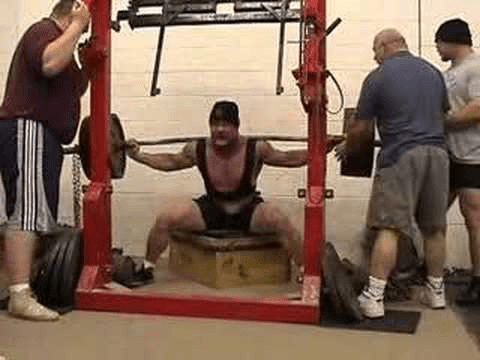
Box squats are a squat variation where the athlete deliberately “sits back” onto a box or bench before driving back up. This removes the bounce often seen in traditional squats and promotes explosive force production from a dead stop. Long favoured by powerlifters, box squats are gaining recognition across sport and tactical settings. Why? Because research shows they develop strength and power just as effectively as traditional back squats, with added benefits in hip dominance and reduced joint stress.
Why Use Box Squats?
1. Same Force and Power as Back Squats
Recent research confirms that box squats produce nearly the same (sometimes slightly higher) peak force and power compared to regular squats, especially at 70–80% of 1RM. This means you can safely swap them into strength programs without compromising results.
2. Higher Rate of Force Development (RFD)
Box squats require you to explode up from a dead stop, significantly increasing RFD. In fact, one study showed 3–4x greater RFD than in regular squats. This makes them ideal for athletes needing quick, powerful hip extension like sprinters, rugby players, or tactical professionals.
3. Hip-Dominant Movement
Box squats shift emphasis away from the quads and toward the glutes and hamstrings. The wider stance and vertical shin angle increase posterior chain involvement, reinforcing hip strength. That’s great for knee health and explosive tasks like jumping, sprinting, or hill climbing.
4. Safer on the Spine and Ankles
Biomechanical studies show lower spinal and ankle joint moments with box squats compared to traditional squats. The controlled descent and vertical shin reduce shearing forces, making them ideal for lifters with joint sensitivities or during in-season training blocks.
5. Useful for Contrast and Complex Training
Box squats work well for post-activation potentiation (PAP) protocols. For example, contrast training that pairs a heavy box squat with a jump can enhance power output. Research shows this works just as well as deadlifts or traditional squats for explosive potentiation.
Box vs. Back Squats at a Glance
| Feature | Box Squat | Back Squat |
|---|---|---|
| Peak Force & Power | Similar or slightly higher | High |
| Rate of Force Development | 3–4x higher | Moderate |
| Joint Stress (Spine/Ankle) | Lower | Higher |
| Primary Movers | Glutes & Hamstrings | Quads & Glutes |
| Safety Features | Box acts as stop/safety | No external safety |
| Stretch-Shortening Cycle | Removed (paused on box) | Active (bounce from bottom) |
Sport-Specific Benefits
- Power Sports (e.g., rugby, sprinting): Enhances hip drive and rapid force production.
- Field and Endurance Athletes: Builds posterior chain strength with lower joint fatigue.
- Tactical Athletes: Develops strength under controlled, safer conditions while maintaining transfer to load-bearing and sprinting tasks.
Coaching Tips
- Set Up Right: Box should be at parallel depth or slightly higher for beginners. Stance should be wider than shoulder width with toes turned out.
- Cueing: Use commands like “sit back,” “vertical shins,” and “explode off the box.”
- Execution: Lower under control, maintain tension on the box (no relaxing), then drive up powerfully.
- Programming: Include both heavy (80–90% 1RM for 3–5 reps) and speed (40–60% 1RM for 3–6 explosive reps) sessions weekly.
Final Thoughts
Box squats are not just for powerlifters. Whether you’re training a sprinter, a soldier, or an aging athlete, they offer an effective, safe, and versatile method to build lower body strength and power. With smart coaching and programming, box squats deserve a permanent spot in the training toolkit.





 Will Strathdee
Leave a comment